

Chain Agnostic Applications
Problem
Appchains often spin up bespoke validator sets, multisigs or custom messaging paths per use case (governance messages, bridges, feeds). Each new route brings another committee, relayer and audit. Latency creeps in through off chain hops, costs grow with validator counts, and security fragments across custom trust assumptions. Native finality and slashing exist, but slashing paths for cross chain outcomes are typically indirect or out of band, and every extra chain or pairing demands new glue code and operations.
Solution
Relay gives appchains a single validation layer for cross chain outcomes. It turns any source chain event into a stake secured attestation that your appchain can verify natively (as a module, contract or runtime component) and act on immediately.
Why this is a fit for any appchains:
- Cheaper at scale. BLS aggregation and optional ZK keep on chain verification costs close to constant even as the operator set grows. This is especially useful when you need to verify large validator sets or frequent updates coming from ecosystems like Ethereum.
- Clearer guarantees. Attestations are backed by bonded stake and explicit slashing rules in Symbiotic. You define the quorum, weights and signing conditions that must be met for your appchain to accept an update.
- Faster to production. A thin adapter (native module, precompile or contract) replaces ad hoc relayers or custom committees. You deploy a single verifier on your appchain and wire it directly into your application logic and state transition rules.
- Portable across stacks. One attestation format, many destinations. The same cryptographic proof can be verified on an appchain today and on an EVM rollup, L2 or other execution environment tomorrow, without redesigning your security model.
- Composable with existing bridges. You can keep using existing bridging stacks (IBC, light clients, CCIP style routers or custom bridges) where they shine, and feed Relay attestations into modules that need external state with explicit slashable guarantees. Proofs can also be handed off to existing routing or governance logic.
- Operator control. You can customize validator sets, quorum thresholds, stake types, challenge windows and slashing rules per appchain or even per message route, aligning Relay’s security model with each application’s specific risk profile.
How it Works
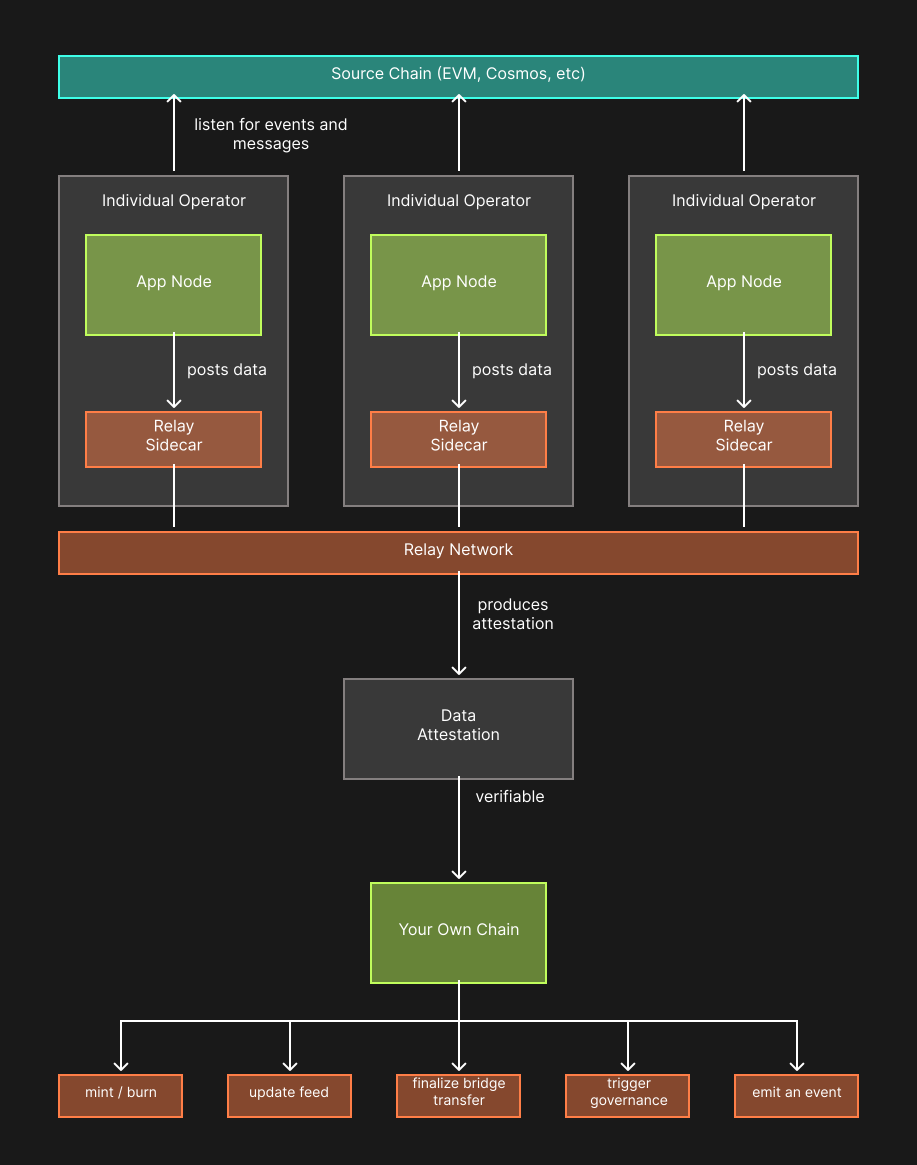
- Observe & package. Off-chain Relay nodes watch a source chain, pick up your event / message, and package it with
{source domain, block/height, nonce, expiry}. - Attest & aggregate. A configurable quorum of operators signs. Signatures are aggregated with BLS and linked to bonded stake in Symbiotic.
- Verify on your appchain. Your appchain verifies the attestation through a light verifier provided by the Relay SDK as a module, contract or runtime component. It checks weights and quorum, metadata, replay protection and the aggregate signature. With optional ZK, verify cost remains close to flat as the operator set grows.
- Settle the outcome. After verification, an adapter module or contract executes. It can mint or burn, update a price feed, finalize a bridge transfer, trigger governance or emit an event for downstream modules. The pattern is the same across stacks so you wire Relay into your appchain using the primitives that are native to your environment.
Application Examples
-
Secure your L1 consensus at genesis (no bootstrap from 0)
Launch without resorting to a centralized multisig or a tiny, weak validator set. Your chain imports slashable economic security directly from a Symbiotic vault: the Relay delivers an attested operator set and weights; your adapter maps those weights to consensus voting power and emits
ValidatorUpdates. Mis-attestations are slashable at the vault, so security is real on day one - no “trust us until we decentralize” phase.Why it matters: you avoid the bootstrapping trap, ship safely on day 1, and can progressively add native stake over time (dual-sourcing security or switching entirely when ready).
-
Canonical mint and burn across two L1s
Keep a single canonical supply without bespoke multisigs. Burns on Chain A are attested through Relay. Your adapter on Chain B verifies and mints with nonces and expiries for replay protection.
-
DEX settlement and intent routing across L1s
Resolve on Chain A, finalize accounting on Chain B. The adapter verifies once and updates balances / positions in your DEX or settlement module.
-
Cross domain oracle or state feeds into an appchain module
Import external state for example LST rates or rollup headers into an oracle or system module on your appchain. Relay provides explicit slashable guarantees together with fixed expiries and clear challenge windows.