

Overview
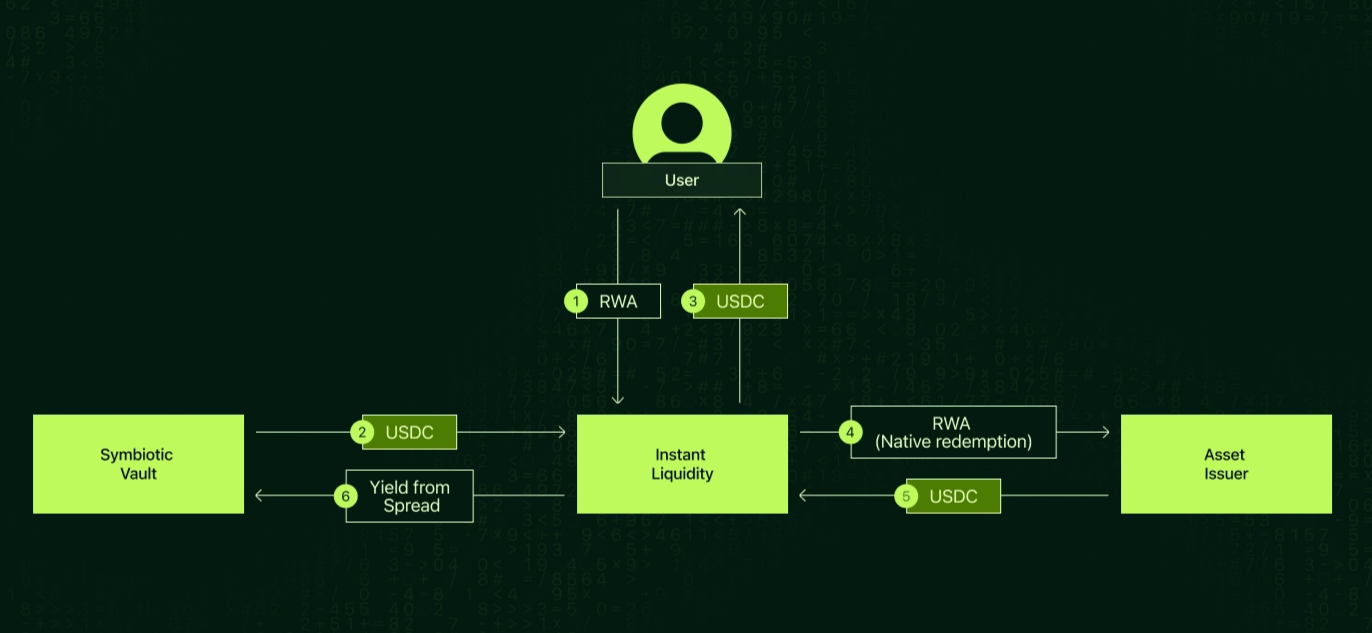
Symbiotic Liquid Lane enables redemptions for otherwise illiquid or time-locked assets by sourcing liquidity from curator-managed Symbiotic vaults. Symbiotic’s collateral management infrastructure facilitates market makers to use vault liquidity for the sole purpose of quoting, filling, and natively processing redemptions via an onchain RFQ workflow.
Vault LPs underwriting this product stand to earn the spread from these redemption flows while continuing to receive base yield on idle funds through DeFi adapters such as Morpho, as well as additional yield from exposure to Symbiotic applications.
Liquid Lane is designed for RWAs and crypto derivative assets (e.g. Liquid Staking Tokens, Vault receipt tokens) where primary liquidity is episodic or constrained (e.g. withdrawal queues, redemption windows, vault lockups), and where market makers can price duration in exchange for composable yield for vault depositors supplying short-term liquidity.
About Symbiotic V2
Symbiotic is a modular collateral and yield infrastructure that lets institutions and applications deploy, manage, and route productive assets across onchain market structures. Backed by Pantera and Paradigm, Symbiotic is built to make collateral programmable: vaults, curators, and adapters can be composed to create market-specific risk and yield profiles.
Liquid Lane is one example of this broader “Collateral Markets” strategy, following the successful collaboration with Cap, where Symbiotic powers >$250m of collateral underwriting borrowers like Susquehanna, M11 Credit, and others. It uses curator-managed, yield-generating vault collateral to underwrite redemption flows for assets whose native liquidity is episodic or time-locked, turning productive collateral into reliable, onchain liquidity while preserving base yield and risk controls.
Key Facts
| Capital Usage | LP capital sits in curator-managed vaults earning base yield from lending markets (and/or delegating to Symbiotic networks) and is deployed when market makers draw liquidity to fill redemptions. |
| Vault LP Yield | Yield generated from market maker usage of vault liquidity (fees/spread share), driven by redemption demand (early exits and liquidations) + base yield from DeFi lending and Symbiotic networks. |
| Typical Duration | Vaults on average have a 14 day lockup period, but a curator may still service liquidity for an RWA redemption that exceeds this window. It is up to curators to manage this based on their different liquidity and risk management practices. |
| Eligible Collateral | USDC (Cohort 0) + wETH & wBTC/cbBTC & other stablecoins (Cohort 1 onwards) |
| Risks | • Product-related risks (duration, liquidity, operational) • Infrastructure-related risks (smart contracts, front- and backend (API), oracle) |
| Settlement | • Native redemption with asset issuer • A second market maker-triggered RFQ sale of the asset |
Supported Assets
- Midas
| Asset | Issuer | Fund Manager / Operator | Accepted Collateral |
|---|---|---|---|
| mF-ONE | Midas | Fasanara Capital | USDC |
| mGLOBAL | Midas | Fasanara Capital | USDC |
| mGLO | Midas | Fasanara Capital | USDC |
| mROX | Midas | RockawayX | USDC |
| mTBILL | Midas | Midas | USDC |
| mRe7YIELD | Midas | Re7 | USDC |
| mAPOLLO | Midas | Apollo Crypto | USDC |
| mEDGE | Midas | Edge Capital (UltraYield) | USDC |
| mHYPER | Midas | Hyperithm | USDC |
| mM1 | Midas | M1 Capital | USDC |
- Centrifuge
| Asset | Issuer | Fund Manager / Operator | Accepted Collateral |
|---|---|---|---|
| JAAA | Centrifuge | Janus Henderson | USDC |
| JTRSY | Centrifuge | Janus Henderson | USDC |
| HYB | Centrifuge | New York Life Investment Management | USDC |
- OpenEden
| Asset | Issuer | Fund Manager / Operator | Accepted Collateral |
|---|---|---|---|
| HYBOND | OpenEden | OpenEden | USDC |
- Hastra / Figure
| Asset | Issuer | Fund Manager / Operator | Accepted Collateral |
|---|---|---|---|
| PRIME | Hastra | Hastra | USDC |
- Pareto
| Asset | Issuer | Fund Manager / Operator | Accepted Collateral |
|---|---|---|---|
| AA_FalconXUSDC | Pareto | M11 Credit | USDC |
Further collateral assets and redemption assets will be added in the future. Interested teams can get in touch with Symbiotic to support specific assets for redemptions or as collateral.
Value Proposition
- Real yield, not points farming: returns come from real demand for liquidity (instant redemptions and liquidations).
- Institutional-grade exposure through delegation: LPs benefit from deploying collateral assets (stablecoins/WETH/WBTC) into curator-managed vaults, without needing to run RFQ quoting infrastructure themselves.
- Risk-managed allocations: curators set asset-specific parameters (limits, counterparties, additional allocations to Symbiotic networks and external lending markets) to control how capital is used.
- Distribution & integrations: the product is designed to plug into wallets, vaults, and RWA issuance/redemption flows, aggregating demand into a single quoting surface.
Reward Profile
Vault depositors stand to earn a blend of three distinct yield sources, depending on the exposure and strategy of their vault’s curator:
- Servicing redemption: Liquid Lane enables vault depositors to earn part of the spread market makers achieve by acquiring discounted assets through RFQ bids and native protocol redemptions (or secondary auctions).
- Liquidity buffer earning base yield: Symbiotic’s collateral management infrastructure enables programmable deployment of collateral to earn base yield while no redemptions are serviced.
- Long-duration exposure: vault collateral can be delegated to Symbiotic application.
Risk Profile
Vaults utilizing Liquid Lane and associated infrastructure are exposed to risks that may differ depending on the vault curators allocations to adapters, the serviced redemption assets, as well as vault-associated bidding strategies in the RFQ process.
Product-related Risks
- Duration risk
- Underlying asset prices may move in unfavorable directions (NAV impairment) leading to loss of value when natively redeeming.
- Lending adapter liquidity risk
- Allocations to Symbiotic DeFi adapters determine how much vault capital is deployed e.g. into lending markets to earn a base yield. Lending market utilization spikes can affect liquidity available for RWA redemptions and vault withdrawals.
- Duration mismatch liquidity risk
- If the vault’s withdrawal delay is shorter than the underlying asset’s redemption window, liquidity may not be available in time to service withdrawals from vault depositors.
- Operational risk
- Curator and RFQ participant-controlled keys and infrastructure determine allocation strategies and bids being placed and can in the case of compromise or mishandling lead to unexpected outcomes. The flow of funds is constrained by Symbiotic core contracts and Liquid Lane-related adapters limiting the surface area.
- RWA liquidity and settlement risk
- For some asset types, native redemption paths may be gated meaning ability to redeem may extend beyond expected dates or face illiquidity for other issuer-related reasons.
Infrastructure-related Risks
- Smart contract, front- and backend infrastructure risk (Symbiotic core contracts, UI and API infrastructure)
- Oracle provider-related risks (asset prices and NAV reporting)
Who This Is For
- Asset issuers looking to expand distribution, improve secondary liquidity, and provide instant redemptions for tokenized products without relying on expensive liquidity incentives or idle capital buffers.
- Institutional LPs (capital providers) who want to earn yield from instant-redemption liquidity demand.
- Vault curators who can underwrite parameters, select/whitelist market makers, and manage allocations to service redemptions, as well as to low-risk DeFi opportunities for idle capital, and Symbiotic networks for additional exposure.
- Market makers that seek to place bids for discounted assets to service redemptions or liquidations, while tapping into onchain vault liquidity.